A Five-Minute Review for the End of the Week
A five-minute end-of-week review helps you notice ease and friction, then choose one small adjustment that fits the week ahead.
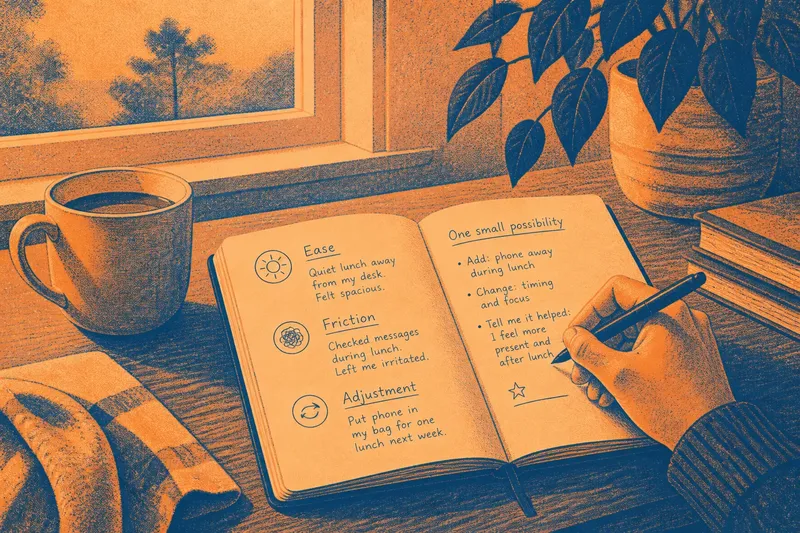
On Friday afternoon, a half-finished mug of tea sits beside your open diary while the week’s loose ends crowd the page. A five-minute end-of-week review can make room for something quieter: one moment that felt easy, one point of friction, and one small adjustment to consider for next week. The aim is not to judge your performance. It is to notice what your days are telling you.
Three ways to review
A useful ritual needs a shape you can return to without turning it into homework. Three approaches can serve the same purpose, but they suit different moods and ways of thinking: a written note, a spoken reflection, or a glance through the week’s calendar.
The written approach is best if ideas become clearer once they are on the page. The spoken version suits someone who thinks aloud or dislikes keeping a personal record. A calendar review helps when the week feels like a blur and you need a concrete prompt for memory.
- Write it down: Use a notebook or a notes app. Leave space for ease, friction and a possible adjustment.
- Say it aloud: Talk through the three prompts while walking home or making a cup of tea. You can stop there, without recording anything.
- Scan the calendar: Look over appointments and commitments, then choose one moment from the week that stands out. Keep the scan brief; the calendar is a cue, not a scorecard.
Say you notice that a quiet lunch away from your desk felt easy, while answering messages during it left you irritated. You might consider putting your phone in your bag for one lunch next week and see how that feels. The adjustment stays small, and the observation remains more important than whether you keep the change.
Start with ease
Ask yourself, “When did the week feel a little more spacious?” The answer does not need to be a grand success. It could be a calm breakfast, an unhurried conversation, a task finished before it became urgent, or a stretch of time when you were not switching between screens.
Describe what happened in plain language. “The walk after work helped” gives you more to work with than “I had a good day”: perhaps the walk marked a boundary between work and home, or gave your attention a break from notifications.
Notice the conditions around the moment, not just the activity. Was there less rushing, a clearer plan, a familiar place, or another person’s company? You are gathering clues about what makes ordinary life feel more workable, not trying to turn a pleasant moment into a rule.
Name the friction
Next, choose one point where the week snagged. It might be a repeated interruption, a task that stayed vague, a commitment that took more energy than expected, or the awkward gap between two plans.
Describe the event before interpreting it. “I opened my inbox between meetings and missed the start of the next call” is specific. “I’m terrible at organising myself” turns one incident into a verdict about your character, which offers little help with next week.
Friction is not always a problem to eliminate. A difficult conversation may have mattered; a demanding day may have been unavoidable. The useful question is narrower: what part of this moment, if any, could you make gentler, clearer or easier to respond to?
Choose a small adjustment
Once you have named ease and friction, choose one possible adjustment. Keep it concrete enough to picture, but modest enough to remain an experiment rather than a promise. “I’ll be more organised” is hard to act on; “I’ll write tomorrow’s first task on a sticky note before closing my laptop” gives you a visible next move.
Use these prompts to shape an option:
- What could I add, remove or move?
- Could I change the timing, place or first step?
- Would a reminder, a note or a conversation help?
- What would tell me whether this felt useful?
Choose a change you can observe without keeping score. If you plan to leave a little space between appointments, you might notice whether the transition feels less rushed. If circumstances shift, you can adapt or drop the idea; the point is to make a thoughtful choice, not to prove your resolve.
Which approach fits?
Should I write the review?
Writing suits you if a few sentences help separate an event from the story you tell about it. A notebook can hold the three observations without demanding a polished diary entry.
Can I do it without journalling?
Yes. Speak the answers quietly to yourself, or think them through while doing a familiar, low-stakes task. If recording personal details feels uncomfortable, there is no need to keep a written account.
What if my week felt like a blur?
Use your calendar, a message thread or a list of errands as a memory prompt, then stop when one moment of ease and one point of friction come to mind. You do not need to reconstruct every day to make a useful observation.
How do I choose an approach?
Choose the format you are most likely to use when you are tired: paper, a spoken pause or a calendar glance. If one feels like another obligation, try a different one; the three prompts matter more than the medium.
Keep the ritual light
A five-minute end-of-week review should fit around real life. Set a gentle timer if you tend to wander into a long analysis, or leave the clock alone if time pressure makes reflection feel like a chore. When the three prompts have answers, you can finish.
Some weeks may offer no obvious moment of ease, or the friction may be hard to name. Write “not clear yet” and leave it there. Forcing a neat lesson can make the ritual less honest than simply noticing that you are tired or distracted.
You can also skip a week without treating the gap as failure. The review is an invitation to pay attention, not a new standard to meet. If a difficult observation points towards a larger issue that needs support, a trusted person or qualified professional may be a better next conversation than a tiny schedule adjustment.
When Friday arrives again, the best end-of-week review may be the one that leaves you with a little more room to choose. Notice what eased the week, name what snagged, and carry forward only one small possibility. The value is in seeing your life more clearly, even when the next week refuses to follow the plan.